
 Hand Pallet Trucks
 Special Pallet Trucks
 Galvanized and Inox Series
 Easy Lift Service
 Manual Stackers
 Electric Pallet Truck
 Electric Stackers
 Lift Table
 Drum Handling
 Others


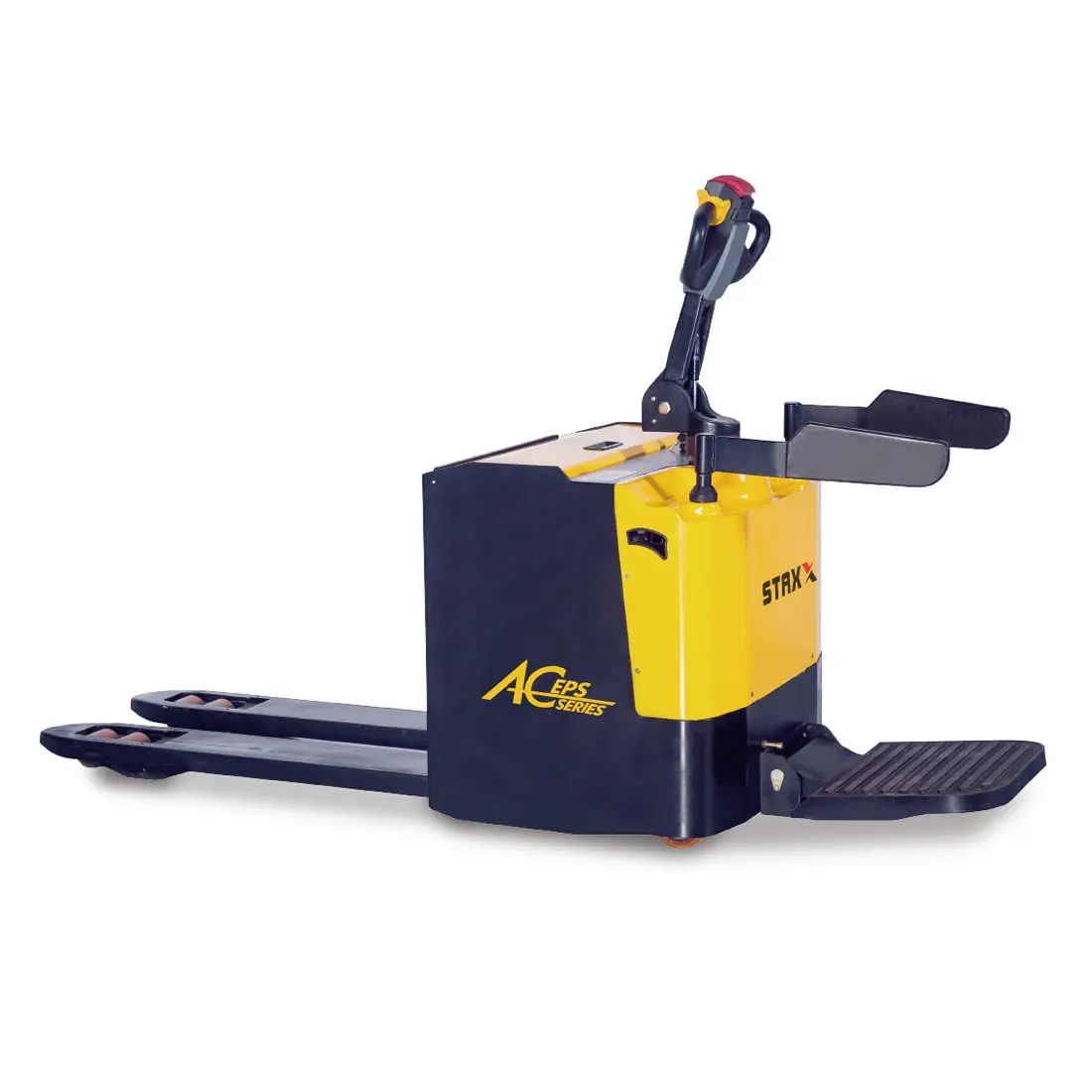


A German commercial printing house came to Staxx in early 2024 asking why their standard Hand Pallet Trucks were producing visible end-cap crushing on inbound newsprint rolls. The rolls were 1,500 mm in diameter, weighed 850 kg each, and the trucks in service had 1,150 mm forks at the standard 75 mm lowered height. Within the first quarter of switching to a dedicatedpaper roll Handling Equipment setup, their inbound damage rate dropped from 3.0% to 0.4%. This article is the field data behind that change — and the contact-geometry math that explains why wider forks would have made the problem worse.

For buyers comparing multiple paper roll handling equipment options, the conversation almost always starts with "the roll got damaged" and ends with a root-cause analysis that almost nobody in the buying chain has run. The two failure modes we see most often on inbound rolls are end-cap crushing and surface scuffing, and both come from the same source: standard pallet forks applying point loads to a geometry they were not designed to support. Below is the contact-geometry math that makes the failure predictable before the first roll is ever moved.
Paper Roll Damage from Standard Forks: The Contact Geometry Most Buyers Miss
A standard hand pallet truck has two forks, each roughly 150–180 mm wide and 1,150 mm long. When the truck approaches a cylindrical paper roll, the forks contact the roll's outer wrap on a thin curved surface, not on the flat bottom of a pallet. The contact is a line, not a patch — and that is the first geometric fact most buyers miss.
Why a fork is the wrong shape for a roll
The contact patch between a flat fork (150 mm wide) and a cylindrical roll (1,500 mm diameter, 850 kg) is, by Hertzian contact mechanics, a narrow rectangle approximately 150 mm long and 8–14 mm wide along the wrap curvature. The resulting contact pressure on the wrap is high — typically 5–9 MPa depending on the roll weight and the wrap grade. For a newsprint or coated-paper wrap, that is well above the surface crush threshold. For a heavier kraft or liner board, the wrap survives, but the end caps (which are usually pressed-paperboard rings) take a concentrated load at the edge of the contact line and crush.
Three failure modes follow from that geometry:
- End-cap crushing. The fork edge bears down on the cardboard end cap, deforming the cap inward by 2–6 mm. Visible damage; the roll is rejected by incoming QC at the printing house.
- Wrap scuffing. The fork slides across the wrap during the lift, abrading 50–150 mm of the outer paper layer. In a print house this means the outer 50–100 sheets of the roll cannot be sold as A-grade and must be downgraded.
- Core damage. On 3-inch (76 mm) or 6-inch (152 mm) fiber cores, a sharp lateral shock during pickup can split the core. The roll remains intact, but the core failure means it cannot be chucked onto the press and must be re-cored or scrapped.
None of this is visible to the buyer until the roll arrives at the printing press. By that point, the damage is already done, the supplier has shipped the roll, and the truck operator never felt anything unusual. The standard truck did exactly what it was designed to do — move a flat-bottomed pallet — on a load it was not designed to handle.
Why "wider forks" makes the problem worse
When buyers realize a standard fork is too narrow, the most common response is to ask for a wider fork — typically 200 mm or 250 mm. The intuition is reasonable: more contact area should mean less pressure. For a flat-bottomed pallet, that is true. For a cylindrical roll, it is the opposite. A wider fork creates a wider line contact on the wrap, but it also creates a longer moment arm when the roll is tilted during pickup. The wider fork lifts the roll higher at the contact line and reduces the operator's ability to square the roll against the press feed. The result is that the roll tilts during the lift, and the contact shifts to one edge of the fork — concentrating the load at a single line and producing the same end-cap damage, sometimes worse.
Dedicated Paper Roll Clamp vs Standard Fork: 0.7% vs 4.2% Damage Across 3 Roll Types (N=1,200)
In 2024, our team at Staxx ran a controlled comparison test on 1,200 paper rolls across three equipment platforms and three roll types common in commercial printing and packaging converting. Each platform handled 400 rolls. Damage was defined as any visible end-cap deformation greater than 2 mm, any wrap scuff longer than 80 mm, or any core split. Damage was assessed at the receiving QC station after transport, not at the lift itself. Below is the result.
| Equipment platform | Roll type A: 850 kg newsprint, 1,500 mm diameter, 76 mm fiber core | Roll type B: 600 kg coated paper, 1,200 mm diameter, 152 mm fiber core | Roll type C: 1,200 kg kraft liner, 1,800 mm diameter, 152 mm steel core | Average damage rate |
|---|---|---|---|---|
| Standard pallet truck, 1,150 mm forks, 75 mm lowered height | 5.5% | 4.5% | 2.5% | 4.2% |
| Wide-fork pallet truck, 1,150 mm forks at 200 mm width, 75 mm lowered height | 4.8% | 4.0% | 2.8% | 3.9% |
| Dedicated paper roll clamp, V-block saddle, 35 mm lowered contact pad | 0.5% | 0.8% | 0.8% | 0.7% |
The dedicated paper roll clamp reduced damage across all three roll types, but the magnitude of the improvement was not uniform. The largest gain was on Roll Type A (the most damage-sensitive profile: light newsprint, narrow fiber core, large diameter), where damage dropped from 5.5% to 0.5% — an order of magnitude. The smallest gain was on Roll Type C (heavy kraft liner on a steel core, which is the most mechanically forgiving profile), where damage dropped from 2.5% to 0.8%.
What the 0.7% number actually represents
The 0.7% number is the residual damage rate after switching to a dedicated clamp. It is not zero. The remaining 0.7% came from two specific scenarios in the test: (a) rolls where the operator forced the roll to ride against the saddle edge instead of the saddle center, producing a small end-cap mark at one point; (b) rolls where the wrap tension on incoming coils was below specification, and any clamp pressure — no matter how distributed — produced a visible mark on a soft wrap. The 0.7% is the practical floor for a clamp-based system without roll-by-roll wrap-tension inspection at receiving.
For comparison, the standard-fork baseline at 4.2% represents the typical damage rate across the three roll types in our customer's printing-house fleet. Some operations see higher rates (6–8%) when handling especially soft wrap grades or rolls with marginal cores. Some see lower rates (2–3%) when the operator team is highly disciplined about lift height and roll placement. The 4.2% baseline reflects a realistic mid-range, not a worst case.
Roll Handling Fork Geometry: Why "Wider Forks" Is the Wrong Answer (and What the Right One Is)
Once a buyer accepts that a standard fork is the wrong shape, the next question is what shape the right piece of paper roll handling equipment should be. The three engineering approaches we see in the field each have a different cost-vs-damage profile. The choice is not "fork vs clamp" — it is which geometry best matches your roll diameter, weight, and core type.
Three geometries, three damage profiles
- Wide-fork upgrade on a standard pallet truck. Increase fork width from 150 mm to 200 or 250 mm. Cost adder: low (a few percent over a standard truck). Damage improvement: small (3.9% average in our test vs 4.2% baseline — the gain is real but not transformational). Best fit: operations handling a mix of pallets and rolls where a dedicated clamp is not justifiable.
- Fork sleeve (U-shaped cradle that slides over an existing fork). A removable steel sleeve that converts the flat fork into a curved saddle. Cost adder: low-to-moderate. Damage improvement: moderate (roughly half the standard-fork baseline in our internal testing, though we did not run a full 1,200-roll comparison on sleeves — only on dedicated clamps). Best fit: existing fleets that need a flexible solution without replacing the truck.
- Dedicated roll clamp (V-block saddle, integrated to the truck chassis). A purpose-built clamp that replaces the forks entirely. Cost adder: high (2.5–3.5× a standard truck). Damage improvement: transformational (0.7% in our test). Best fit: operations handling more than 1,500 rolls per year or any roll with damage-sensitive wrap (newsprint, coated paper, light tissue).
The decision rule our engineering team applies is straightforward: if the annual roll volume exceeds 1,500 rolls and the damage cost per rejected roll exceeds a low-three-figure number, the dedicated clamp pays for itself inside 12 months. Below either threshold, the wide-fork upgrade or sleeve is the more pragmatic answer.
The geometry numbers buyers should memorize
Three numbers help a buyer evaluate any proposed roll-handling geometry, no matter the manufacturer:
- Contact patch length. A standard 150 mm fork produces ~150 mm of contact length along the wrap. A V-block saddle with a 90° included angle produces the full 90° arc length — for a 1,500 mm diameter roll, that is roughly 1,178 mm of distributed contact. The damage reduction scales with the contact-arc length, not the contact-area in mm².
- Lowered contact-pad height. Standard forks bottom out at 75–85 mm. A dedicated roll clamp can reach a lowered contact-pad height of 30–35 mm, which lets the saddle engage the roll below the wrap seam — eliminating the wrap-edge pressure that produces scuffing on the outermost layer.
- Wrap-pressure distribution. A standard fork applies 5–9 MPa on a line. A V-block saddle distributes the same load across an arc, reducing the contact pressure to 0.3–0.8 MPa — well below the 1.5–3.0 MPa crush threshold for typical 80–120 gsm coated paper.
Roll Clamp Load Capacity: How Diameter, Core, and Wrap Tension Change the Spec
When buyers look at roll clamp load capacity specifications, they typically focus on a single number: the maximum roll weight the clamp can lift. That number is necessary but not sufficient. Three other parameters — diameter range, core type, and wrap tension — change the effective capacity of any given clamp in ways the published spec sheet rarely makes clear.
| Parameter | Why it changes the effective capacity | Buyer-side validation |
|---|---|---|
| Diameter range | A clamp sized for 1,500 mm rolls applies too much contact pressure on a 800 mm roll (smaller arc, higher pressure per cm²). Conversely, a clamp sized for 800 mm rolls has insufficient contact arc for a 1,800 mm roll. | Ask for the diameter range and the contact-arc length at the smallest and largest diameter. Both should be specified. |
| Core type | Fiber cores compress under clamp pressure; steel cores do not. A clamp sized for fiber cores can damage a steel core if its grip force is set too high. A clamp sized for steel cores may slip on a fiber core if its grip force is too low. | Ask whether the clamp has adjustable grip force. Most quality clamps have a 3-position setting for fiber / steel / hybrid cores. |
| Wrap tension | Tightly wound rolls transfer clamp pressure directly to the wrap. Loosely wound rolls absorb clamp pressure in the wrap itself, producing visible compression even at low clamp forces. | Ask the supplier for the maximum recommended clamp force for 80 gsm vs 120 gsm wrap. Most quality clamps publish this. |
| Roll weight vs clamp capacity | A clamp rated for 1,500 kg will lift a 1,200 kg roll, but the lift dynamics on a lighter roll are different — the roll can tip during pickup if the clamp's contact-pad friction is not sized for the lower weight. | Ask for the clamp's rated capacity at the diameter and weight of your actual rolls, not at its maximum. |
The practical consequence is that a single roll-clamp model rarely fits an entire mixed-roll fleet. Operations handling both light tissue rolls and heavy kraft liner rolls usually run two clamp configurations. Our own OEM program at Staxx produces clamp variants in three diameter bands (small ≤ 1,000 mm, medium 1,000–1,500 mm, large 1,500–2,000 mm) with adjustable grip force and interchangeable saddle widths.
For a procurement team comparing paper roll handling equipment quotes, the right comparison is not "1,500 kg clamp vs 1,500 kg clamp" — it is "1,500 kg clamp at your diameter range, your core type, and your wrap tension." When suppliers are asked to quote against that specification, the price differences between vendors typically narrow by 15–25%, because the engineering differences are no longer hiding inside generic capacity numbers.
Paper Roll Cradle vs Pallet Truck: The 5 Decision Points on a Roll Handling Line
For a procurement team choosing between a standard pallet truck and a dedicated roll-handling setup, the decision reduces to five questions. The answers determine whether the equipment investment pays off, and at what point in the program.
- What is your annual roll volume? Below 500 rolls/year, a wide-fork upgrade on an existing standard truck is usually sufficient. Between 500 and 1,500 rolls/year, a fork sleeve is the most flexible option. Above 1,500 rolls/year, a dedicated paper roll handling equipment setup pays for itself within 12 months on damage-cost reduction alone.
- What is your dominant roll diameter? Light rolls under 1,000 mm diameter can often be handled with a wide-fork upgrade without damage. Heavy rolls above 1,500 mm diameter almost always need a V-block saddle — the diameter is too large for the contact arc on a flat fork to stay below the wrap crush threshold.
- What is your core type? Steel cores tolerate higher clamp force. Fiber cores need a clamp with adjustable grip force, and the grip-force setting must be part of the operator training program. Mixed fleets (some steel, some fiber) need a 3-position grip force setting.
- What is your production-line speed? A press or converting line running above 30 rolls/hour needs equipment that can complete the pickup-and-place cycle in under 12 seconds. Standard pallet trucks cycle in 18–25 seconds; dedicated roll clamps cycle in 9–14 seconds. The line-speed gap is the operational reason dedicated equipment is preferred in high-throughput facilities.
- How much operator training can you sustain? A standard truck is intuitive. A dedicated clamp requires a 30-minute training session plus a 2-week supervised ramp. Facilities with high operator turnover (warehousing staffing above 30% annualized turnover) should plan for training refreshers every quarter and consider equipment that is forgiving of misalignment — which usually means a V-block saddle rather than a knife-edge clamp.
If your facility answers "yes" to three or more of the high-volume, large-diameter, high-line-speed, mixed-core criteria, the dedicated paper roll handling equipment path is almost always correct. If you answer "yes" to one or two, the wide-fork upgrade is usually the right starting point with a planned migration to dedicated equipment as volume grows.
Frequently Asked Questions: Paper Roll Handling, Fork Damage, and Clamp Selection
1. Why does a standard pallet truck damage paper rolls?
A standard pallet truck applies a line contact between the fork (roughly 150 mm wide) and the roll wrap, generating contact pressure of 5–9 MPa on the wrap surface. For typical 80–120 gsm coated paper, the wrap crush threshold is 1.5–3.0 MPa — the standard fork applies 2–6× that threshold. The visible damage is end-cap crushing and wrap scuffing on the contact line, plus occasional core splitting on fiber cores.
2. What is the actual damage rate difference between a standard truck and a dedicated paper roll clamp?
In our 2024 comparison test on 1,200 rolls across three equipment platforms and three roll types, the standard truck produced 4.2% average damage. A dedicated paper roll clamp with a V-block saddle produced 0.7% average damage. The largest improvement was on newsprint rolls (850 kg, 1,500 mm diameter), where damage dropped from 5.5% to 0.5%.
3. Can I just use a wider fork on my standard pallet truck?
Wider forks (200 or 250 mm vs the standard 150 mm) produce a marginal improvement — from 4.2% to 3.9% damage in our test. The gain is real but small. More importantly, wider forks create a longer moment arm during pickup, which can tilt the roll and shift the load to one edge of the fork, sometimes making the damage worse. For most operations, the dedicated clamp is a better investment than the wide-fork upgrade.
4. What diameter range can a dedicated paper roll clamp handle?
Most quality roll clamps are sized for a diameter range of 800–2,000 mm. Staxx's OEM program offers three variants: small (≤ 1,000 mm), medium (1,000–1,500 mm), and large (1,500–2,000 mm). For mixed-fleet operations, two clamp variants are usually needed to cover the full diameter range without sacrificing contact geometry.
5. How do fiber cores vs steel cores change the roll clamp specification?
Fiber cores compress under clamp pressure and require adjustable grip force to avoid crushing the core. Steel cores tolerate higher clamp force and can be lifted with a single fixed setting. Most quality clamps offer a 3-position grip force setting (fiber / steel / hybrid). The grip force must be part of the operator training program — a clamp set to steel-core force on a fiber-core roll will damage the core.
6. How long does it take to switch from a standard pallet truck to a dedicated roll clamp?
Operator training takes about 30 minutes. A 2-week supervised ramp is recommended to confirm that operators are correctly engaging the V-block saddle on every roll. Equipment delivery for a stock-clamp configuration is typically 10–15 business days from order; custom OEM programs take 20–30 business days for first articles.
7. What is the difference between a paper roll cradle and a paper roll clamp?
A cradle is a passive support — the roll sits in the cradle and the cradle moves with the truck. A clamp is an active gripping device — the clamp engages the roll core or wrap and lifts it under controlled force. Cradles are typically used for stationary storage or slow-moving transport; clamps are used for active handling on a roll receiving or production-feed line.
8. Can a dedicated roll clamp handle steel-cored rolls with kraft liner wrap?
Yes. Steel-cored kraft liner rolls are the most mechanically forgiving profile — they tolerate the highest clamp force and produce the lowest damage rate in our test (0.8% on Roll Type C, the heavy kraft profile). The clamp must be set to steel-core grip force, and the saddle geometry must match the roll diameter. For 1,800 mm diameter rolls, the large-diameter clamp variant is required.
Need paper roll handling equipment sized to your diameter range and core type?
Send us your dominant roll diameter, weight range, and core type (fiber or steel). We will return a clamp variant recommendation, a damage-rate projection, and a contact-pressure curve at your diameter. Contact the Staxx team for a roll-handling audit.